


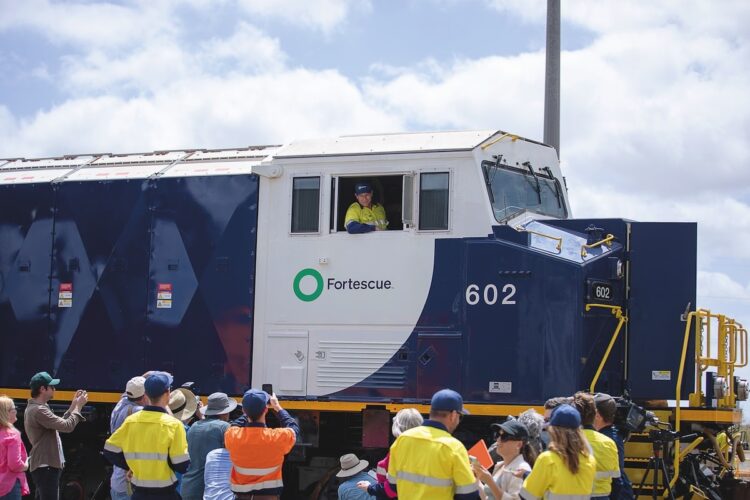
Fortescue has signalled it will resist pressure from China’s centralised iron ore buyer as the mining giant accelerates electrification of its Pilbara operations and develops new revenue streams beyond iron ore.
At the company’s annual general meeting, executive chair Andrew Forrest defended Fortescue’s position in negotiations with China Mineral Resources Group (CMRG), while outlining plans to commercialise its expanding renewable energy infrastructure.
The developments come as Fortescue navigates uncertainty in its largest export market following a record year for iron ore shipments.
Chief executive officer Dino Otranto said Fortescue shipped more than 200 million tonnes of iron ore in financial year 2026, generating underlying EBITDA of $US8.6 billion, underlying net profit after tax of $US3.5 billion and free cash flow of $US3.2 billion.
The company paid a full-year dividend of $1.08 per share, representing a 65 per cent payout ratio.
China negotiations test Fortescue’s resolve
Forrest reaffirmed Fortescue’s position in negotiations with CMRG, which is seeking greater influence over iron ore pricing.
“We will be negotiating fairly and properly with CMRG,” Forrest said.
“That doesn’t mean that we need to cave into demands which we don’t think are in the best interests of shareholders or in the best interests of our country. And those negotiations are ongoing.”
Sharesies Australia head of capital markets Jacki Neumann said Fortescue had managed the disruption by holding ore in inventory, although that strategy could not continue indefinitely.
“Fortescue has already flagged that production could be adjusted if talks run past year end,” Neumann said.
“The risk is that a drawn-out dispute turns deferred sales into lost volume, and a more lasting drag on earnings.”
ETF Shares chief investment officer David Tuckwell said Forrest’s refusal to concede ground was a defining feature of the meeting.
He said Fortescue was relying on its low production costs to strengthen its negotiating position, although the outcome remained uncertain.
Tuckwell also noted that China’s tightening environmental requirements were creating challenges for Fortescue’s traditional iron ore products, with projects such as Iron Bridge intended to address the quality gap.
Electrification becomes a commercial opportunity
Fortescue’s energy transition is increasingly being positioned as an opportunity to reduce mining costs and generate revenue from external customers.
Its Pilbara Green Grid now includes more than 1.3 gigawatts of solar and wind generation operating or under construction, supported by more than 550 kilometres of high-voltage transmission infrastructure.
The company has signed a 20-year power purchase agreement with PLS to supply its Pilgangoora lithium operation, establishing an external customer for the network.
Tuckwell said the agreement demonstrated Fortescue’s potential to become a commercial electricity supplier rather than simply generating renewable energy for its own operations.
Otranto said battery-electric equipment was already delivering encouraging results.
“We have electric excavators, drills, locos, water carts, dozers, loaders, and graders across all of our sites […] they’re already outperforming their diesel counterparts.”
Fortescue expects its first 240-tonne battery-electric haul truck to arrive in the Pilbara within weeks, with management forecasting potential unit-cost savings of $2–4 per tonne over the next few years.
The company is also deploying artificial intelligence for operational monitoring and rail scheduling, while its Paulex software is designed to operate heavy machinery across different equipment suppliers.
Solar installation has reached more than 6000 panels daily, with automation trials aimed at increasing deployment rates.
Forrest reiterated Fortescue’s real-zero emissions target for 2030, while identifying 2028 as an internal ambition for eliminating oil, gas and diesel from operations.
“But if we need to compete with the rest of the world, we go automated and we go robotic,” Forrest said.
Copper offers a longer-term growth option
Fortescue is pursuing diversification into copper and critical minerals, although its near-term earnings remain heavily dependent on iron ore.
Chief executive officer, growth and energy, Gus Pichot said copper would be central to the company’s strategy.
“Beyond iron ore, copper will drive our diversification,” Pichot said.
Fortescue plans to begin drilling at its Cañariaco copper project in Peru by the end of 2027, alongside exploration programs in Argentina, Kazakhstan, Canada and Australia.
Tuckwell said copper received relatively limited attention at the AGM despite its strategic importance.
He suggested Fortescue was wary of paying elevated acquisition multiples for established copper mines, favouring exploration opportunities and proprietary technology.
That includes its Toowong copper-processing technology, which targets high-arsenic concentrates.
Fortescue is also examining opportunities to supply renewable energy to industries including green hydrogen, fuels and data centres.
Shareholders seek investment returns
Shareholder questions focused on capital allocation, previous investment losses, executive succession and governance.
Neumann said uncertainty surrounding the China negotiations increased the importance of balancing growth expenditure with shareholder distributions.
“The renewable energy investment has a clear long-term cost rationale,” she said.
“Signed agreements to sell surplus power would help show it can also generate revenue.”
Tuckwell noted that shareholder support for Fortescue’s leadership remained strong despite share-price weakness, pointing to Forrest’s re-election with 98.08 per cent support and approval of the remuneration report with approximately 99 per cent.
Fortescue’s immediate challenge is to protect iron ore earnings while demonstrating that electrification can deliver lower costs and its emerging energy and copper businesses can generate meaningful returns.
Forrest said the company’s established industrial base provided the foundation for its longer-term ambitions.
“Let’s use our massively successful industrial base, which is a huge consumer of energy, to turn fully green, to make all our own power, to have all our own energy assets owned by you as shareholders, to continue making all our own energy forever,” he said.