


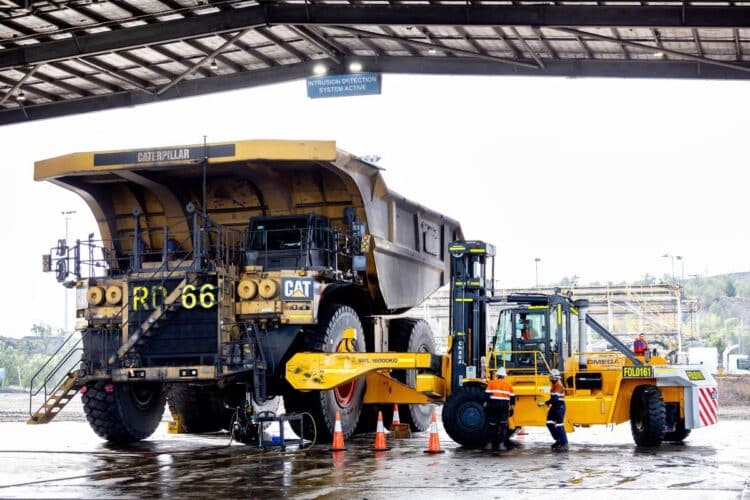
BHP will trial Caterpillar’s Dynamic Energy Transfer system in the 2026–27 financial year as it works to reduce diesel consumption across its mining operations.
The technology would allow battery-electric haul trucks to charge while moving, potentially reducing the time vehicles spend stationary during charging.
BHP group officer for sustainability and social value Maria Palomar said replacing diesel-powered equipment would require changes beyond introducing electric machinery.
“Electric fleets need new charging, power and operating models, and those changes can affect safety, productivity, cost, congestion and reliability at scale,” she said.
BHP estimates that a theoretical 220-tonne class battery-electric haul truck with a 3MWh battery would require six to eight charging stops every 24 hours, each lasting approximately 30 minutes. A comparable diesel truck typically refuels once every 24 hours in approximately 15 minutes.
The company estimates the additional charging requirements could result in approximately 1000 lost hauling hours annually for one truck, or 100,000 hours across a fleet of 100 vehicles.
BHP is examining dynamic charging along high-traffic haul routes as one option to address the productivity implications of electrification.
The planned Caterpillar trial forms part of BHP’s broader efforts to achieve net-zero operational greenhouse gas emissions by 2050.
The company reported that its operational emissions in the 2025–26 financial year were 33 per cent below its 2019–20 baseline, while renewable sources accounted for 80 per cent of electricity supplied to its operated assets globally.
BHP is targeting a reduction in operational emissions of at least 30 per cent by 2030, although the company has acknowledged that emissions could increase temporarily as production expands.
Renewable electricity currently accounts for 35 per cent of electricity supplied to Copper South Australia and up to 30 per cent at Western Australia Iron Ore’s Port Hedland operations.
BHP Mitsubishi Alliance also moved to 100 per cent renewable electricity from July 2026, based on forecast demand.
Alongside electrification, BHP is assessing hybrid equipment, alternative power systems and sustainably sourced biofuels as potential measures to reduce diesel consumption.
Palomar said the company’s technology trials would inform future investment decisions.
“Each trial is designed to build the evidence base: what works, what does not, and what still needs to mature before major investment decisions are made,” she said.