

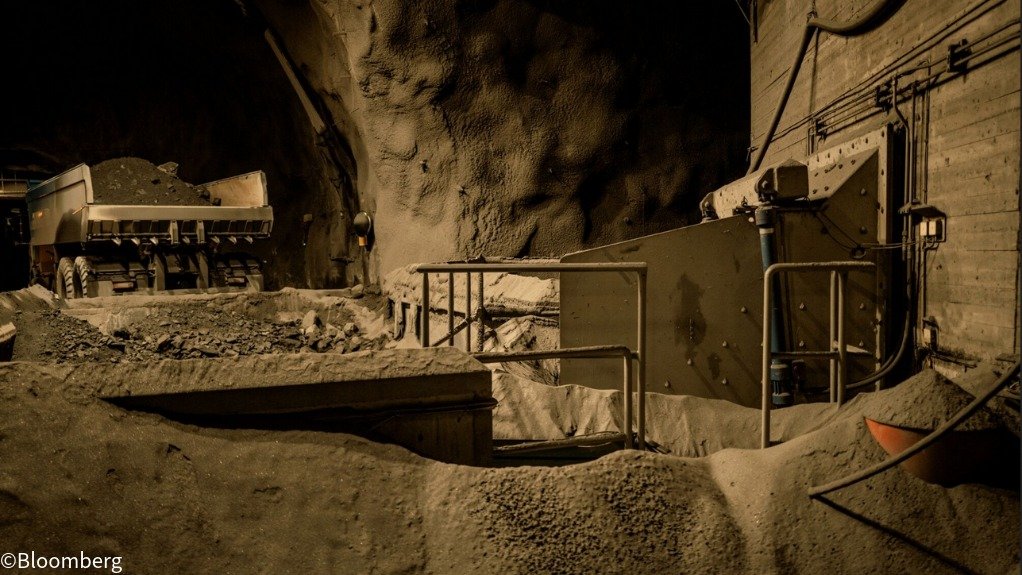
Deep inside the Arctic Circle, more than 1 000 m underground, the smell of ammonia lingers in the tunnels of the Malmberget mine in Northern Sweden after nightly explosions that loosen 50 000 tons of rock.
For more than a century, it’s churned out iron-ore, playing a huge part in the country’s economic history. Now, those blasting operations are also the first stage of a quest to build a viable supply chain for rare earths in Europe.
Those minerals have become some of the 21st century’s defining commodities, used in everything from electric cars and wind turbines to data centers and defense equipment. Reducing Europe’s dependence on imports, particularly from China, has become an urgent issue as the materials increasingly get used as economic leverage.
The Nordic region is emerging as a cornerstone of the effort. It combines the continent’s largest known deposits with abundant clean power and established mining expertise. Sweden’s State-owned LKAB, which operates Malmberget, is in a particularly advantageous position given the minerals are a by-product of its profitable iron operations, meaning it doesn’t have to build everything from scratch.
Mining alone won’t be enough, however. To succeed, Europe has to borrow from China’s playbook, where government support helped the country build massive processing and refining capacity to fully exploit its huge deposits.
“In the West, if we really want to win this whole chain of how rare earths work, you need to think like China, not just about the rare earth mine,” said Eldur Olafsson, CEO of Amaroq, which has an exploration project in Greenland.
It will cost more than €43-billion ($48-billion) to complete the dozens of strategic projects that the EU has earmarked for development under its Critical Raw Materials Act, according to estimates from the bloc. Some of LKAB’s operations and several other rare-earth projects are included.
But the cost of doing nothing is even greater. The International Energy Agency sees a potential $1.5 trillion hit from supply disruptions, centered in sectors like automotives, electronics and aviation.
The capital costs are intended to be funded through a mix of public resources and private investment.
Nordic governments are beginning to put money behind the emerging supply chain, using grants and research funding to support projects stretching from exploration to processing and separation. The EU has a €3-billion fund for critical mineral projects, including rare earths. However, the numbers so far are much less than the spending by China — as well as the US, which has also been pushing to reduce its reliance.
China accounts for about 60% of global mined production of magnet rare earths. For refining, the grip is even tighter, more than 90% of global output.
Madalena Barata da Rocha, a research analyst at the Brussels-based think tank Bruegel, said China has shown that it’s “willing and capable of weaponizing this supply chain.”
In 2025, Europe got a taste of that concentration risk when Beijing tightened exports of rare earths and battery materials. Tensions persist as the EU imposes restrictions on a range of imports to protect some of its industries.
At Malmberget, the nightly blasting is just the start. The iron-ore is separated, and the by-product goes through various stages to obtain apatite concentrate, which can be further processed to produce phosphoric acid and rare earth elements.
About 190 km (118 miles) south, in a non-descript industrial building in Luleå, the next stage of the supply chain is starting to happen at a pilot processing plant. Completed on schedule, the focus is now on the hot commissioning phase, when everything is gradually tested to ensure it will perform as intended under actual operating conditions.
LKAB has invested about 800-million kronor ($85-million) so far. A full-size plant, which could be operating in the early 2030s, will be a multi-billion krona investment. Darren Wilson, senior vice president for special products, says most will come from LKAB, but it’s exploring other financing too, “given the project’s significance for Sweden and Europe.”
“It’s not about being self-sufficient, it’s about reducing dependency,” he said. “To have enough to make a strategic difference.”
The plans in Europe stretch right across the supply chain.
LKAB is also the largest shareholder in Norwegian refiner REEtec. A rare-earth magnet factory in Estonia has begun commercial production, owner Neo Performance Materials Inc. said in September.
For years, importing was easier, and high costs and uncertain returns made rare earths an unattractive proposition for many of the West’s biggest miners. That created a dangerous dependence, such as Europe had with Russian natural gas.
There is a “strategic vulnerability, and we are determined to reduce it,” EU industry commissioner Stéphane Séjourné said. “This means mining more in Europe where we have resources, but also processing and recycling more and diversifying our supplies.”
Some of LKAB’s projects have been designated Strategic Projects by the EU, including the yet-to-be-developed Per Geijer deposit in northern Sweden, which contains much higher concentrations of rare earth elements and phosphorus compared with the ore bodies LKAB currently mines. The EU is also pushing offtake agreements to buy future output, to create revenue certainty for companies and private investors.
Across the region, a range of sites are at various stages of development, including Amaroq’s Ilua project in Greenland and Sokli in Finland, which could cost up to €1.5-billion to develop.
“The market economy in itself cannot deliver this change,” said Peder Lundquist, CEO of Denmark’s Export and Investment Fund, one of the largest shareholders in Amaroq. “We have to learn from the best,” he said, referring to China.
Another project is the Fen Carbonite Complex in Norway. It may be Europe’s largest deposit, with an estimated 15.9-million metric tons of total rare earth oxides.
Developer Rare Earths Norway this month announced a pilot processing plant for the site, with about a third of the cost coming from public money. It has indicated it’s open to state ownership as part of any future investment.
For now, the continent’s manufacturers — and their customers — remain heavily exposed to a risky supply chain.
Höganäs AB uses rare-earth elements primarily in surface coating materials for energy, aviation and defense, and sources material from China. CEO Henrik Ager sees Europe’s push as vital.
“The benefit for the consumer of securing supply of rare earth elements is not lower-cost products,” he said. “It is military defense capability, supply of power, access to basic products and the ability to travel as we know it today.”