


Around a century ago, Karaganda didn’t really exist. Coal had been discovered here in the late 19th century, but the nascent mines were soon abandoned – for some reason it proved difficult to persuade people to leave their families behind and toil down the pit in the middle of the frigid steppe. Besides, there were too few houses and nowhere near enough food to supply a large-scale mining settlement. But all that changed in February 1927, when Article 58 of the Russian penal code was brought into force.
Article 58 justified the arrest of those suspected of counter-revolutionary activity. The law cast a wide net as the precise meaning of “counter-revolutionary activity” was left deliberately vague, leaving Alexander Solzhenitsyn to ask: “Who among us has not experienced its all-encompassing embrace? In all truth, there is no step, thought, action, or lack of action under the heavens which could not be punished by the heavy hand of Article 58.”
People may not have fancied moving to the steppe, but fortunately for economic planners the Soviet justice system had suddenly created a large pool of laborers who had little choice in the matter.
Between 1921 and 1953, an estimated 18 million people passed through the Soviet forced-labor camp system known as the Gulag. The number of those who died is disputed, but is thought to be around 1.5 to 1.6 million. These numbers suggest that while the Gulag experience was unimaginably brutal, it was not necessarily the death sentence it is often portrayed as.
The Karaganda Camp (or Karlag) was created in 1930 to solve the problem of supplying the coal mines. It grew so rapidly that, by 1940, the area of the camp covered 6,500 square miles and was home to 65,000 prisoners. The Kazakh SSR became a repository for all manner of “undesirables,” from the political dissidents convicted under Article 58 to the so-called rich peasants, or kulaks, who were seen to be standing in the way of the equal distribution of land. They were joined by whole groups of “disloyal” ethnicities such as Poles and Chechens, Koreans and Crimean Tatars. In the early 1940s, half a million ethnic Germans, who had been living along the banks of Russia’s Volga River for almost two centuries, were also forced to relocate here.
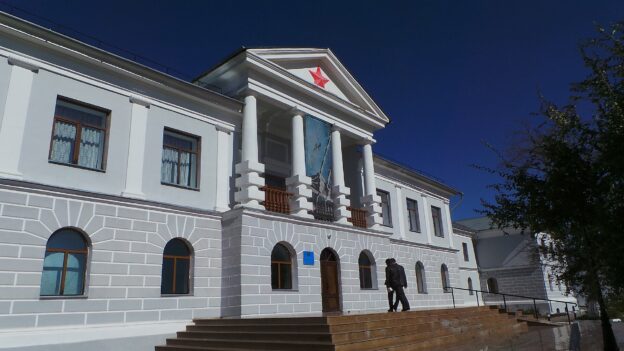
Between them they played a large part in the building of Karaganda, which went from a small settlement in the late 1920s to a city of over 200,000 twenty years later. The camp headquarters, and now the site of the Karlag Museum, was in a small town called Dolinka, about 30 miles from Karaganda proper. There are few other visitors, so the young woman at the ticket office is happy to give me a free tour.
She takes me to the dormitories first. It’s draughty even at the height of summer. Rough woolen sheets filled with straw are draped over bunk beds whose supporting planks are so thin I doubt they would have supported any but the scrawniest of inmates – though I suppose the diets here were unlikely to have left anyone particularly rotund.
“Local people used to ride here on horseback and throw kurt over the walls of the camp for the prisoners to eat,” my guide tells me.
Kurt is a hard, extremely salty ball of dried cheese. It’s not particularly appetizing but lasts a long time and has been used for centuries as a protein-rich snack for those spending days in the saddle. The traditional Kazakh diet is heavy on these milky staples. Another is kumis – fermented horse’s milk – which I was made to sample on my first evening here. It wasn’t the tastiest of concoctions, but I imagine that both kurt and kumis would hit the spot if you’ve been forced to build a coal mine on Oliver Twist’s rations.
I also imagine that this story isn’t true – the idea of noble, empathetic Kazakh horsemen coming to the aid of the desperate, oppressed prisoner is, well, a stretch. However, there is well-documented evidence of large-scale black-market trade in food and rations in the Karlag, whose walls were more porous than other camps due to its size and proximity to Karaganda.
We come to the commandant’s study, set up as it would have been in the early 1950s: portrait of Stalin on the wall behind the desk and some heavy bookshelves, well stocked with the works of Lenin, Marx, and Engels. The only touch of personality is betrayed by an old gramophone.
“Concerts were organized on Sundays and Mondays,” she tells me. “Those were the days when the prisoners were tortured; the music drowned out the screams.”
The other rooms are dedicated to the fate of the Kazakhs – that is, the people who had lived here for centuries before these lands became an integral part of the Gulag.
In 1897, under the tsars, the land we now call Kazakhstan was 82 percent Kazakh. The early years of the 20th century saw the authorities encourage Slavic people to settle in the areas that had traditionally been inhabited by Kazakh nomads.
“Kazakhs lived at one with the steppe,” Klara, an IT worker who lived in Kazakhstan’s capital, Astana, had told me before my trip. As soon as she found out about my post-Soviet odyssey, she made it her mission to make her country my next destination.
“They traveled to where food and water was before moving on. This way, the land was allowed to recover in the meantime. The European arrivals began to change that, and the Soviets put it on fast-forward. They were obsessed with collectivizing people. The idea of being a nomad didn’t fit into their concept of a worker-led revolution. Maybe Marx skipped our role in his grand theory of history,” she said, giving me a wan smile.
The result of this crash-collectivization was famine. The room has exhibits on the famines of 1919–22 and 1932–3. Kazakhs suffered disproportionately as they lived on fertile land that could produce a lot of wheat. They were forced to abandon their nomadic lifestyle and produce food first for the Red Army, and then for Stalin’s five-year plans. Those who resisted were shot. Many fled to China or Mongolia. Many more starved.
In the Soviet census of 1926 the Kazakh population was 3.6 million; by 1939 this had dropped by a third to 2.3 million. By 1959 Kazakhs numbered a mere 30 percent of the population of the Kazakh SSR.
Along with the demographic assault came the attempts to destroy Kazakh identity. The room next door has a small exhibition dedicated to the entire class of Kazakh intellectuals who were exterminated in the purges of the late 1930s. Just as their way of life was destroyed and their people forced onto farms, their thinkers, authors, and anyone who might be able to articulate the uniqueness of the Kazakh identity were wiped out by NKVD bullets.
Klara had told me about the legend of the Mankurt.
“When a warrior was captured in battle, his head would be shaved by his captors and a piece of damp camel skin would be wrapped tightly around it. He would then be left, tied up in the desert sun, which would dry the camel skin and cause it to contract. His hair would also have no room to grow, so it would grow inwards, into his skull. The resulting pressure on the head would break the prisoner’s mind, causing him to lose all memory, all sense of self, all knowledge of his past and his family. Once broken, he became the perfect slave: the Mankurt, loyal only to his master.”
The story sounds like an ancient steppe legend, but it actually comes from “The Day Lasts More Than a Hundred Years,” a novel by the celebrated Kyrgyz writer Chingiz Aitmatov. The Mankurt became a powerful metaphor across Central Asia for a people stripped of their history and identity. That was precisely how Klara saw the Soviet experience.
“This is what the Soviets did to the Kazakh people, to all the people of Central Asia. They tried to destroy us so completely that we would not even recognize who we were,” said Klara.