

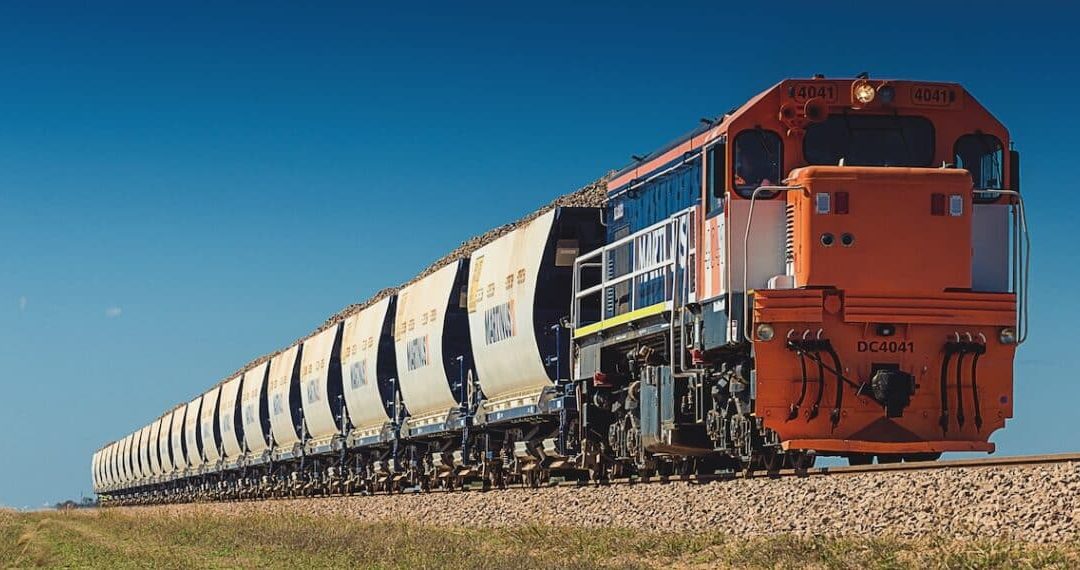
Martinus is helping shape Australia’s mining and logistics future through large-scale rail infrastructure, haulage expertise and customer-focused supply chain solutions.
Before a locomotive moves any iron ore, grain or coal across the country, there is an immense amount of engineering beneath the steel rails that makes the journey possible, where every section of track must withstand enormous weight, constant vibration, and the relentless pressure of haulage.
Martinus understands this structure especially well, having laid out thousands of kilometres of track across Australia since its inception in 2005, including the Carmichael rail network in Queensland and the Murray Basin rail project in Victoria.
What began as a small Sydney-based business supplying specialist rail products has since evolved into Australia’s largest privately owned rail infrastructure company, employing more than 1900 people across four countries.
Founded by chief executive Treaven Martinus, the company initially focused on supplying rail products before clients began requesting installation expertise alongside the materials themselves. By 2012, Martinus had expanded into rail construction and just a year later secured four major tenders that accelerated the company’s growth trajectory.
Those projects included upgrades at BlueScope’s Port Kembla coal terminal, ARTC’s Gunnedah yard rationalisation works, Aurizon’s Hexham stabling facility, all in New South Wales, and the Moreton Bay Rail Project in Queensland.
The momentum continued in 2017 when Martinus secured its first major contract, valued at $250 million, before expanding internationally into Chile in 2020 and later into the US through the acquisition of Bottom Line in 2023.
But despite its rapid expansion, the company’s core philosophy has remained unchanged: understanding what customers need before prescribing a solution.
“The first question we always ask is, ‘What’s not working in your supply chain?’” Martinus national business development manager – haulage Lee Morrissey said.
“That opens up the conversation to the places where we can really have an impact and make a difference in clients’ haulage and logistics.”
That customer-first approach has become particularly valuable within Australia’s mining sector, where rail infrastructure often determines how effectively commodities move from mine to port.
The Carmichael rail network in Queensland demonstrates that capability. Working collaboratively with Bravus Mining and Resources through an early works agreement, Martinus delivered the civil and track packages for the project under a self-delivery model that utilised local contractors and internal workforces.
The project involved constructing 210km of track, delivering two flash butt welding yards, completing 15,000 flash butt welds and installing more than 600,000 tonnes of ballast. On the civil side, Martinus completed 86km of rail formation works, constructed 10 major bridges and installed more than 40km of culverts.
At peak construction, the project involved more than 600 workers and contractors and delivered more than $70 million in spending within local communities. The project also exceeded social sustainability targets, including a nine per cent Indigenous employment rate.
Martinus also played a central role in Victoria’s Murray Basin Rail Project, a $440 million infrastructure initiative jointly funded by the Victorian and Federal governments to strengthen regional freight capacity.
Under a joint venture partnership with McConnell Dowell, Martinus helped upgrade more than 1000km of rail lines from broad gauge to standard gauge, rebuilt the closed Ararat–Maryborough corridor and improved axle load capabilities across sections of the network.
The project included replacing 274,000 sleepers, welding more than 50,000 rail joints into continuously welded rail and upgrading nearly 400 level crossings. Across the life of the project, the delivery team achieved 38 per cent Indigenous participation.
For Morrissey, Martinus’ ability to deliver large-scale infrastructure while adapting to customers’ operational realities remains a defining advantage of the company.
“There’s a lot of haulage agreements that come with a take-or-pay element, which means you’ll be paying revenue no matter what your mine does,” he said.
“We’re trying to flip the script. Our customers should be able to continue with their mining, and we’ll build a contract that suits their business.”