


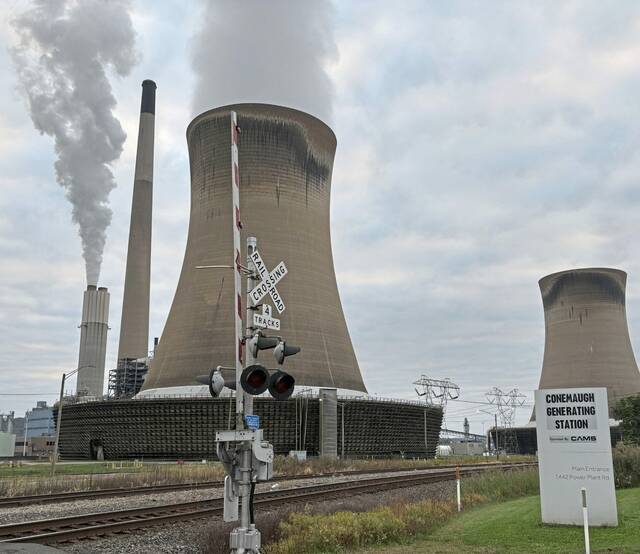
The Trump administration and state regulators have thrown a lifeline to the owners of two coal-fired power plants in Indiana and Armstrong counties.
A rollback of federal emissions regulations and a state consent decree will give the facilities more time to clean up plant pollution flowing into local waterways and billowing into the air.
The consent decree between Keystone-Conemaugh Projects LLC of Blairsville and the Department of Environmental Protection paved the way for the company to reverse its September 2021 decision to close its two 1,710-megawatt plants by December 2028. The Conemaugh Generating Station across the Conemaugh River from New Florence and the Keystone Generating Station, which straddles the Indiana-Armstrong border near Shelocta, were in danger of being shut down.
The decision was applauded by PJM, the regional transmission grid that manages the distribution of power for 13 states, including Pennsylvania.
Pennsylvania has been a willing partner in addressing permitting reforms that will help all of these projects start contributing additional electricity to the grid, said Jeff Shields, a spokesman for PJM.
“PJM has been very clear that we need all the electricity generating resources we can get during this period when the growth in demand for electricity is outpacing supply. That includes keeping existing resources online, (until) the resources needed to replace them can get built,” Shields said.
The Conemaugh and Keystone plants are able to supply electricity to nearly 50% of all housing units in the state, said James Locher, chief operating officer for Keystone-Conemaugh, in testimony before the state Senate resources and energy committee in May 2023.
Not only do the plants provide power, they provide a significant economic boost. The two plants provide about 250 highly skilled jobs and generate indirect jobs and business for the mining, transportation, equipment, maintenance and technology service sectors with an annual estimated statewide impact of $750 million, Locher said.
Under the consent decree, the company agreed to spend millions on wastewater treatment improvements for the bottom coal ash treatment this year and flue gas desulfurization by 2028. Treated wastewater from the Conemaugh plant flows into the nearby river and the treated Keystone plant wastewater goes into Crooked Creek, an Allegheny River tributary. The company would have to pay an additional $100 million to further treat the wastewater discharge from the power plants to meet the regulations from 2022, Locher told the state Senate committee.
The bottom ash system upgrades at the Conemaugh plant will be operating by the end of the year, stated Georgianna R. Stenger, assistant plant manager, in an Oct. 20 affidavit for the DEP. The improvements to the coal ash system at the Keystone power plant must be completed by Nov. 18, and then will be inspected by the DEP, said Tom Decker, a DEP spokesman.
Locher and Stenger did not respond to request for comment.
Surging power demands
In deciding in mid-September to roll back the Biden administration regulations on power plant greenhouse gas emissions, the EPA said the 2024 Carbon Pollution Standards exceeded the environmental regulator’s authority by requiring power plants to implement pollution control technologies that have not been adequately demonstrated.
Recent power capacity market results have encouraged some power generation resources to remain operating or upgrade their capacity, while also attracting more than 600 new projects that are now seeking interconnection, Shields said. Among those projects are 29 megawatts of power generated by coal resources.
PJM has called upon the Conemaugh units to address power system constraints several times in recent months, Stenger said in her affidavit.
“The question of whether particular power plants should remain open underscores the challenge facing PJM: making sure the region has enough electricity to meet growing demand, both today and in the years ahead, while protecting consumers,” said Todd Snitchler, president of the Electric Power Supply Association, a trade group based in Washington, D.C.
“It helps substantially with the (PJM) power grid. It essentially will give them (at least) four more years,” said Matthew Mackowiak, director of government affairs for Core Natural Resources, which was formed in January 2025 through a merger of CONSOL Energy and Arch Natural Resources.
Keystone-Conemaugh’s decision to keep the plants operating past the previously projected closure date reverses a trend in the Keystone State that has seen about 36 power plants close since the turn of the century; 17 have stopped producing power since 2009, leaving just 13 utility-scale coal-fired power plants operating in the state.
But, rather than blaming environmental regulations for the closing of coal-fired power plants like Homer City in 2023 or the Cheswick Generating Station in Springdale in 2022, the real cause has been the lower natural gas prices used in generating electricity, said former state DEP Secretary David Hess.
Emission rule rollbacks
Pennsylvania last month joined 13 other states in filing a federal lawsuit against the Trump EPA for repealing three parts of the Biden administration’s greenhouse gas emissions rules for coal-fired power plant and those using natural gas. The suit seeks to reinstate the emission requirements.
The EPA in mid-September rolled back the old regulations on the grounds that the Biden administration exceeded its authority under the Clean Air Act by requiring plant operators to implement pollution control technologies that have not been adequately demonstrated. The EPA signaled it may remove all remaining requirements limiting power plant emissions.
To the Pennsylvania Coal Alliance, federal regulators made the right call on repealing the power plant rules on carbon emissions, said the Harrisburg-based trade organization.
Those standards, which never took effect, relied upon technology that has never been adequately tested, the coal alliance said.
“The policies under the Obama and Biden administrations were advanced with the intent to prematurely shutter coal plants and other sources of American energy, drive up rates, and put our electric grids at risk,” said Rachel Gleason, executive director of the coal alliance, in a statement.
Separate from that issue, the Biden administration EPA settled with Keystone-Conemaugh in 2024 over the Conemaugh plant’s failure to comply with coal ash regulations by failing to install a monitoring system to check the groundwater from the ponds that filter the ash. It would cost the company an extra $100 million investment to comply with those wastewater treatment requirements, Locher told the state Senate in 2023.
By repealing those rules, the EPA said it was saving power plant owners a $310 billion federal threat from investing in pollution controls.
The EPA reversed the pollution standards even though the agency’s data shows electricity generation accounts for 25% of greenhouse gas emissions across national economic sectors — just 3 percentage points behind transportation. Coal generated 16.6% of U.S. electricity last year, while natural gas accounted for 40.8%, according to the U.S. Energy Information Administration.
Environmentalists say the Trump administration’s lifting of stricter standards on power plant emissions has set back efforts to reduce pollution.
“We’re horrified. … It is disgraceful that the (Trump) administration would have this rule come out. The administration is getting rid of common sense rules (previously) vetted by the EPA,” said Annie Fox, a staff attorney for the Clean Air Council in Pennsylvania.
The Trump EPA wants to repeal the finding that greenhouse emissions harm human health and reduce the monitoring of elements such as cadmium and arsenic, which are critical to measuring compliance, Fox said. Despite the current administration saying that those pollution controls have yet to be tested, EPA had previously found that those pollution controls were technologically feasible, Fox said.
“There will certainly be lives lost and economies destroyed,” said Fox, who specializes in the power plant permitting process.
Mercury and fine particulates billowing out of coal-fired smokestacks cause respiratory problems and toxicity, Hess said, noting that while the fine particulates cannot be seen, they can be tasted in the air.
Pennsylvania has been a leader in implementing rules to limit power plant emissions, making a lot of progress, he added.
“I would hate to go back to those days. That would really roll back all of those (pollution) standards. The (Trump) administration is on target to roll things back,” Hess said.