


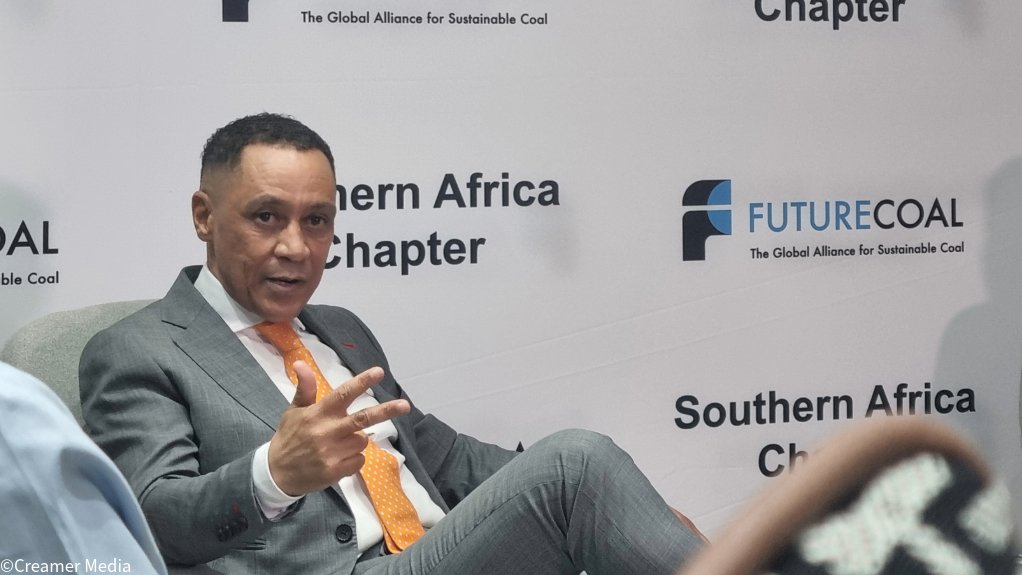
South Africa‘s coal sector, and nonprofit research organisation CoalTech Research Association, which is funded by coal industry organisations, must focus on defining the role of coal in the country’s energy mix, as the amount of coal mined and traded globally continues to climb, said coal and energy company Seriti Resources CEO Mike Teke.
In 2008, six-billion tons of coal were mined global, with 800-million tons traded by sea. In 2025, nine-billion tons of coal were mined worldwide and seaborne trade in coal had doubled to 1.5-billion tons, he pointed out.
Further, the energy ecosystem was evolving and a journey from South Africa‘s economic centre towards the east would reflect this, as it crossed the coal mines, coal-fired power stations, coal-to-liquids plants and wind turbines.
Seriti, which started as a coal mining company, has diversified into wind power and, as an energy company, reaps the rewards of providing both energy sources.
“We do not need to defend coal. Coal will continue to be present in energy mixes around the world. Coal remains a reliable, affordable and widely used source of power. South Africa‘s generation will continue to be underpinned by coal.
“It will be part of the journey of the energy transition. We have to define where coal comes into the energy story and into the balancing act of the energy mix,” he told the CoalTech Colloquium on May 28.
With renewables’ intermittency, battery energy storage and flexibility in mixed-energy economies, baseload would continue to be provided by coal, he added.
While praising the quality of research undertaken by universities on behalf of and funded by CoalTech, Teke said the research should be used to inform the improvement of operations of companies in the industry and progress the future of coal.
Similarly, research had to support and underpin progress in addressing challenges in water stewardship in the mining and coal mining industry.
“We should be ahead of the game and research on water stewardship should help us stay ahead. We cannot be accused of only digging holes and then leaving, or polluting streams and water sources.
“Our mines must master the art of investing and growing assets, as well as rehabilitation programmes and water stewardship. We must be responsible.
“If balanced properly, when data, energy and water are used effectively, organisations will thrive. When underpinned by research, coal will not be accused of being archaic when the energy story is discussed, but will have data and insights into its role.”
If South Africa were to grow its GDP by about 3% a year, which was more than double its current rate of economic growth, it would require more power. Economic growth would not take place without energy and CoalTech must be at the centre of this conversation, he recommended.
“Our research must make the industry better, more productive and support it in creating value while it is responsible for water, rehabilitation and protection of the environment. Research must drive performance of the industry across all these issues, which will ensure that coal remains relevant.”
CoalTech’s research benefits the entire industry, not only its seven member organisations, and Teke called on CoalTech to turn research into clear actions for the industry, and to forge new partnerships with other universities to broaden research capacity.
“Our research ensures we remain relevant and credible in our actions. We need to leverage the data we have to derive insights to determine our actions.
“And this is not only in terms of mining. While mines sometimes have to deal with challenges caused by a lack of service delivery in municipalities, and should not become municipal service providers themselves, they must support communities, and data helps with this.”
Additionally, coal mines must not neglect their environmental responsibilities and must rehabilitate mines and manage water resources diligently.
“CoalTech is at the centre of helping us ensure that the most effective rehabilitation and water management methods are identified and deployed. Data has been captured, and CoalTech must use it to highlight effective practices.
“We have a responsibility for sustainability. As an industry, we must maintain our agility and dynamism, stay informed and adapt fast.
“The future is driven by data, data, data. We must be relevant and continue to define the story of coal,” said Teke.